Main Page
From New World Encyclopedia
New World Encyclopedia integrates facts with values. Written by certified experts.
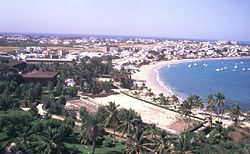
Featured Article: Dakar
Dakar, the largest city of Senegal, is located on the Cape Verde Peninsula, Africa's westernmost point. It is Senegal's political, cultural, and economic capital, and one of Tropical Africa’s leading industrial, financial, and service centers. It is considered one of West Africa’s most important and vibrant cities. Its bustling and cosmopolitan atmosphere compares with some European cities, owing to more than a century of French rule. Dakar is a major transit point for Atlantic Ocean and European trade. Its location significantly helped Dakar's growth into a regional port.
Popular Article: Antigen
An antigen is a molecule that stimulates a response from the immune system, such as bacteria, viruses, foods, toxins, and foreign cells. The word originated from the notion that antigens can stimulate antibody generation. It is now known that the immune system does not consist only of antibodies. The modern definition of antigen encompasses all substances that can be recognized by the adaptive immune system, which includes both the antibody-based humoral immune system and a system that does not utilize antibodies, the cell-mediated immune system.

Did you know?
Sir Isaac Newton, generally regarded as one of the most accomplished and influential scientists in history, wrote more on religion than on science (source: Isaac Newton)


